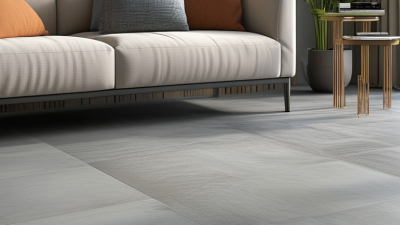
The 2026 market for Homogeneous Vinyl Floor is becoming more competitive and technically demanding. Hospitals, schools, laboratories, and transport facilities require surfaces that withstand heavy traffic and frequent cleaning. Manufacturers must therefore balance durability, hygiene, design flexibility, and environmental responsibility.
This guide examines leading homogeneous vinyl floor manufacturers worldwide through practical, verifiable criteria. These include production capacity, product consistency, safety documentation, installation support, warranty terms, and compliance with recognized international standards. It also considers real project needs, such as welded seams, rolling loads, chemical exposure, and maintenance costs. A hospital corridor, for example, may need a dense surface that tolerates disinfectants without losing its appearance.
Factory experience matters.
However, no global ranking is flawless. Public information differs between regions, and some manufacturers disclose more technical data than others. Distributor feedback may also reflect local service rather than total product quality. For that reason, this overview should support professional evaluation, not replace it. Buyers should request current test reports, product samples, environmental declarations, and references from comparable projects.
The featured companies represent different strengths. Some focus on healthcare flooring, while others offer broad commercial collections or stronger regional support. Their positions may change as technology, raw material costs, and sustainability requirements develop. Careful comparison remains essential. An attractive brochure cannot prove long-term performance. Field evidence can.
Homogeneous vinyl flooring is a resilient floor covering made from one consistent layer. Its color and pattern extend through the full thickness. This structure differs from layered products with a printed decorative film. Most formulations combine PVC, pigments, stabilizers, plasticizers, and mineral fillers. Some products also receive a factory-applied protective treatment.
The structure supports heavy daily traffic. Scratches may be less noticeable when the color runs through the material. Heat-welded seams can create a continuous, hygienic surface. However, installation quality still matters. Poor subfloor preparation can cause ridges, bubbles, or open joints. Moisture testing is essential before adhesive application. A clean floor is not always a dry floor.
Hospitals, clinics, schools, laboratories, offices, and retail spaces commonly use this flooring. Healthcare areas may benefit from fewer dirt-catching joints and simple routine cleaning. Schools often require strong resistance to rolling loads, chair movement, and frequent washing. Laboratories need flooring that matches chemical-resistance requirements, not just attractive appearance. That distinction is easy to miss.
When comparing global manufacturers in 2026, buyers should examine product composition, wear performance, slip resistance, indoor-air documentation, welding guidance, and maintenance data. Independent certifications can strengthen confidence, but certificates should match the exact product and region. No floor solves every problem. Homogeneous vinyl can still stain, dent, or fail when installers ignore moisture, seams, or unsuitable cleaning chemicals.
How to Evaluate Leading Homogeneous Vinyl Floor Manufacturers in 2026
A credible evaluation starts with evidence, not showroom appearance. Grand View Research’s 2024 resilient flooring analysis identifies commercial buildings as a major demand segment. This matters because hospitals, schools, and offices require stable performance under heavy traffic. Ask manufacturers for abrasion results, dimensional stability data, and batch consistency records. Homogeneous vinyl should maintain its pattern through the full wear layer. Request samples from different production dates. Small differences can reveal weak process control.
Standards provide useful discipline. ISO 10581 specifies requirements for homogeneous polyvinyl chloride floor coverings, while ASTM F1913 covers commercial resilient flooring performance. Do not accept a certificate without checking its scope, testing laboratory, and expiry date. Environmental Product Declarations can also support comparison. However, EPD results depend on declared units and system boundaries. They are helpful, but not perfectly interchangeable. I have seen technically impressive products fail because installation guidance was vague.
Tips: Compare at least three technical datasheets. Check slip resistance, fire classification, VOC emissions, and maintenance chemicals. Review warranty exclusions carefully. Ask for project references with similar traffic levels. Inspect welded joints and corner details on a live site, not only in photographs. Consider product availability, spare rolls, and technical training. A low purchase price may hide higher cleaning labor. That calculation is often missed. Finally, record every test method and reporting date before making a 2026 shortlist.
A practical, brand-neutral framework for evaluating homogeneous vinyl flooring manufacturers. The weighting reflects the factors commonly reviewed in commercial flooring procurement, including durability, safety, sustainability, installation support and lifecycle value.
Durability and compliance should receive the greatest attention because homogeneous vinyl floors are frequently specified for healthcare, education, transportation and other high-traffic environments. Product comparisons should be verified against applicable standards such as ISO 10581 for homogeneous PVC floor coverings, ISO 10874 for use classification, EN 13501-1 for reaction to fire, and project-specific indoor-air-quality requirements.
The percentages represent an evaluation model, not market share, sales results or performance scores for any individual manufacturer.
Global leaders in homogeneous vinyl flooring production are judged by more than factory size. They combine stable formulations, precise calendering, and strict surface inspection. European producers often lead in healthcare and education projects, where hygiene and weldability matter. Asian manufacturers are expanding through automated lines and competitive export capacity. North American facilities remain influential in specification-driven commercial flooring.
Experienced buyers should examine batch consistency, not only sample appearance. A strong product keeps color, thickness, and dimensional stability within controlled limits. Manufacturers with ISO 10581 testing, documented quality systems, and traceable raw materials offer greater reliability. However, certifications do not replace practical evaluation. A floor may pass laboratory tests yet perform poorly under rolling loads or harsh cleaning routines. That is an easy point to overlook.
Tips: Request production samples from different batches. Check seams after heat welding. Ask for maintenance records from similar buildings. Review slip resistance, acoustic data, and installation guidance together. Do not judge sustainability by recycled content alone; verify lifecycle evidence and take-back arrangements. One concern remains: global production claims can sound impressive without transparent factory data. Buyers should question energy sources, testing laboratories, and warranty conditions. Small details matter. A careful audit often reveals more than polished marketing language.
In 2026, leading homogeneous vinyl floor manufacturers will compete through regional expertise, not factory size alone. East Asian producers often provide high-volume output, automated welding, and flexible color matching. European facilities usually emphasize low-emission materials, refined surface designs, and strict environmental documentation. North American manufacturers often perform strongly in healthcare, education, and public projects, where maintenance data matters.
Southeast Asian production can offer competitive labor and efficient ocean access. However, consistency may vary between factories. International coverage depends on more than export volume. Reliable suppliers maintain regional warehouses, technical teams, installation training, and responsive after-sales support. They also adapt products to local fire, slip-resistance, indoor-air-quality, and accessibility requirements. Third-party test reports help, but they never replace factory audits or sample inspections. A supplier may look impressive online and still struggle with urgent replacement orders.
Tips: Compare complete regional coverage, not just unit prices. Request recent batch samples, installation references, and quality records. Check whether technical support speaks your market’s language. Confirm lead times during peak construction seasons. Ask how the supplier handles shade variation, damaged rolls, and discontinued patterns. Small gaps become expensive on large projects.
2026 Top Homogeneous Vinyl Floor Manufacturers Worldwide?
Sustainability is reshaping homogeneous vinyl flooring, from factory recipes to end-of-life planning. The 2023 Global Status Report for Buildings and Construction states that buildings consumed 32% of global energy and produced 34% of global carbon dioxide emissions. Flooring is only one component, but procurement teams now examine every square metre.
Material transparency matters. Environmental Product Declarations, verified under ISO 14025 and EN 15804, can disclose raw materials, energy use, emissions, and disposal impacts. The European Environment Agency reports that construction and demolition waste represents more than one-third of Europe’s total waste. This makes take-back systems and recyclable formulations increasingly valuable. Some manufacturers are reducing virgin content and designing products for easier separation. Progress remains uneven.
It needs scrutiny.
Innovation is also practical. Digital production controls can reduce shade variation and installation waste, while low-emission formulations support healthier indoor environments. Independent testing should confirm abrasion resistance, slip performance, indoor air emissions, and service life. A 2024 report from the International Energy Agency highlights continued pressure to cut industrial energy demand, encouraging manufacturers to use renewable electricity and more efficient curing processes. Yet recycled content alone does not prove sustainability. A short-lived floor may create greater impact than a durable one with fewer recycled inputs. Buyers should compare verified lifecycle data, maintenance needs, warranty conditions, and regional recovery infrastructure before ranking global suppliers.
Global benchmark table for evaluating homogeneous vinyl flooring manufacturers and product portfolios without ranking or disclosing individual company or brand data.
| Evaluation Dimension | Relevant Benchmark or Technical Indicator | Why It Matters for Homogeneous Vinyl Flooring | 2026 Market Direction | Verification Reference |
|---|---|---|---|---|
| Product Construction | Single-layer homogeneous PVC construction through the full product thickness | Allows the floor to be mechanically cleaned and periodically refurbished because the wear surface is not a separate decorative layer. | More products are being designed for long service life, repairability, and lower replacement frequency. | ISO 10582:2021; EN 649 classification framework |
| Commercial Durability | Use classifications 34 and 43 for very heavy commercial and industrial applications | Classification helps specifiers match flooring performance to traffic intensity and intended use. | Healthcare, education, transport, retail, and public-sector projects continue to favor high-abrasion products. | ISO 10874:2009; EN ISO 10874 classification system |
| Wear Resistance | Abrasion resistance evaluated under standardized test methods rather than by thickness alone | Homogeneous flooring has no separate wear layer, so abrasion performance and maintenance behavior are critical purchasing criteria. | Manufacturers are emphasizing dense surfaces, improved polyurethane treatments, and lower-maintenance finishes. | ISO 10582:2021; EN 660-2 abrasion testing |
| Indoor Air Quality | Low-emission performance supported by chamber testing and VOC documentation | Low emissions are important in schools, hospitals, offices, and other continuously occupied buildings. | Demand is shifting toward independently tested low-emission products and transparent chemical declarations. | ISO 16000 series; EN 16516; building-emission assessment schemes |
| Chemical Transparency | Disclosure of material composition, additives, plasticizers, and substances of concern | Material transparency supports safer procurement, regulatory compliance, and end-of-life sorting. | Product passports, ingredient disclosure, and third-party material-health assessments are becoming more influential. | EU REACH Regulation; ISO 14021; Health Product Declaration framework |
| Phthalate Strategy | Use of documented non-phthalate plasticizer systems where applicable | Plasticizer chemistry affects regulatory compliance, indoor-air requirements, and sustainability claims. | Buyers increasingly request explicit plasticizer declarations instead of relying on general “phthalate-free” statements. | EU REACH Annex XVII; applicable national chemical regulations |
| Recycled Content | Pre-consumer and post-consumer recycled PVC content reported separately by percentage and mass basis | Separating the two sources prevents ambiguous sustainability claims and improves life-cycle accounting. | Recycled-content targets are increasing, while quality control remains essential for color, emissions, and durability. | ISO 14021 environmental claims; ISO 14040 and ISO 14044 life-cycle assessment principles |
| Recyclability | Design for collection, separation, contaminant control, and closed-loop or open-loop PVC recycling | Recycling performance depends on take-back logistics, adhesive removal, contamination, and available recycling capacity—not only on product composition. | Manufacturer-led take-back programs and recycled-feedstock partnerships are expected to expand. | VinylPlus sustainability framework; ISO 14021 recycling claims |
| Life-Cycle Carbon | Global warming potential reported as kg CO₂e per declared unit with defined system boundaries | Comparable carbon data requires consistent assumptions for raw materials, manufacturing, transport, installation, maintenance, and end of life. | Environmental Product Declarations are becoming a standard procurement requirement for major construction projects. | ISO 14025; EN 15804+A2; product-specific EPD programs |
| Manufacturing Energy | Energy consumption, renewable-electricity share, and manufacturing emissions disclosed at site or product level | Production energy can materially affect the embodied carbon of resilient flooring. | Factories are adopting renewable power purchasing, process-efficiency projects, and more detailed Scope 1 and Scope 2 reporting. | GHG Protocol Corporate Standard; ISO 50001 energy-management principles |
| Water and Process Control | Documented water consumption, wastewater controls, and process-chemical management | Water stewardship and chemical control help reduce manufacturing impacts and operational risk. | Environmental reporting is moving from broad corporate statements toward site-level performance indicators. | GRI 303: Water and Effluents; ISO 14001 environmental-management systems |
| Fire Performance | Reaction-to-fire classification assessed for the complete installed flooring system where required | Fire performance can depend on the flooring, adhesive, substrate, and installation configuration. | Project specifications increasingly require tested system documentation rather than standalone product claims. | EN 13501-1; local building codes and tested floor-system assemblies |
| Slip Resistance | Slip-resistance performance documented for the intended wet or dry application | Slip behavior is a major safety consideration in healthcare, education, hospitality, and public facilities. | Manufacturers are improving surface texture and maintenance guidance while balancing cleanability and stain resistance. | EN 13893; DIN 51130 and DIN 51097 where applicable |
| Healthcare Hygiene | Weldable seams, impervious installation detailing, cleanable surfaces, and compatibility with disinfectants | Continuous and properly sealed installations reduce areas where dirt and moisture can accumulate. | Healthcare specifications increasingly combine flooring performance with infection-control and maintenance protocols. | ISO 10581/ISO 10582 product standards; project-specific healthcare guidance |
| Installation and Adhesives | Compatible low-emission adhesives, moisture testing, seam treatment, and installation instructions | Adhesive selection and subfloor preparation affect indoor air quality, service life, and future removal. | Adhesive-free, reduced-adhesive, and mechanically recoverable installation concepts are receiving greater attention. | EN 14259; ISO 16000 series; manufacturer installation specifications |
| Maintenance Efficiency | Documented cleaning frequency, chemical consumption, water use, and refurbishment requirements | Operational impacts can exceed manufacturing impacts over a long service life, especially in high-traffic buildings. | Low-maintenance surface treatments and machine-cleaning compatibility are key innovation areas. | ISO 14040/14044 life-cycle assessment principles; facility-maintenance documentation |
| Certifications and Declarations | Third-party EPD, ISO 14001, ISO 50001, indoor-air, material-health, and quality certifications | Independent verification improves comparability and reduces reliance on unsupported environmental marketing claims. | Procurement teams are favoring suppliers with aligned, auditable documentation across multiple facilities and regions. | ISO 14001; ISO 50001; ISO 14025; recognized EPD and building-product programs |
| Digital Product Information | Digital technical files containing composition, performance, installation, maintenance, and end-of-life information | Structured data enables BIM coordination, environmental assessment, compliance checks, and future material recovery. | Digital product passports and machine-readable sustainability data are expected to become more common in international projects. | EU Ecodesign for Sustainable Products Regulation framework; BIM data practices |
| Global Supply Resilience | Multi-region production, qualified raw-material sources, documented quality systems, and delivery traceability | Resilient supply chains reduce project delays and improve consistency across international installations. | Buyers are placing greater value on regional production, dual sourcing, and transparent logistics emissions. | ISO 9001 quality-management principles; ISO 28000 supply-chain security guidance |
| Future Innovation Priorities | Lower-carbon formulations, higher verified recycled content, improved recyclability, bio-based feedstocks, and smart maintenance data | Future competitiveness will depend on combining durability, health, circularity, cost control, and measurable environmental performance. | Leading suppliers are expected to compete on verified life-cycle results rather than isolated “green” product features. | ISO 14040/14044; ISO 14025; EU circular-economy and sustainable-products policy direction |