How to Choose Homogeneous Vinyl Tile for Global Projects?

Choosing Homogeneous Vinyl Tile for a global project involves more than comparing colors, prices, or thickness. The decision affects infection control, maintenance, indoor air quality, and lifecycle cost. Grand View Research identifies resilient flooring as a growing global market, supported by healthcare, education, retail, and transportation construction. Fortune Business Insights also reports continued expansion in the vinyl flooring sector, especially where durability and installation efficiency matter.

As flooring specialist Brett Miller observes, “The floor is the foundation of the room.” That principle becomes practical on a hospital corridor, where welded seams, rolling loads, and frequent disinfecting shape product selection. A reliable Homogeneous Vinyl Tile should be evaluated against relevant standards, including ISO 10582, EN 649, ASTM F1913, and applicable regional slip-resistance requirements. Technical data should also confirm wear-layer construction, dimensional stability, chemical resistance, fire performance, and emissions testing.

Yet global procurement is rarely perfectly predictable. A product that performs well in a dry European office may need different adhesive control in a humid Southeast Asian school. Local substrate conditions can quietly change the result. This is where published test reports, installer experience, and manufacturer support become essential. Not every attractive specification reflects actual site performance.

This guide examines how to compare Homogeneous Vinyl Tile across climates, building types, compliance systems, and maintenance programs. It considers the details that are easy to overlook: pallet storage, seam visibility, floor preparation, replacement access, and cleaning chemicals. The strongest choice is not always the cheapest or thickest option. It is the product that remains dependable after years of daily use.
How to Choose Homogeneous Vinyl Tile for Global Projects?

Project Requirements and Performance Goals

How to Choose Homogeneous Vinyl Tile for Global Projects

Project Requirements and Performance Goals

A successful specification starts with the building, not the sample board. Record room function, traffic volume, trolley routes, cleaning routines, and expected service life. A hospital corridor needs different resistance than a quiet hotel bedroom. It may sound obvious. It is often missed.

Measure the substrate carefully. Moisture, flatness, cracks, and temperature can affect installation and long-term appearance. In a coastal school, tracked-in water and sand may demand stronger slip resistance and easier maintenance. In a dry inland office, static control and dimensional stability may matter more. Ask local installers about seasonal conditions. Drawings rarely show everything.

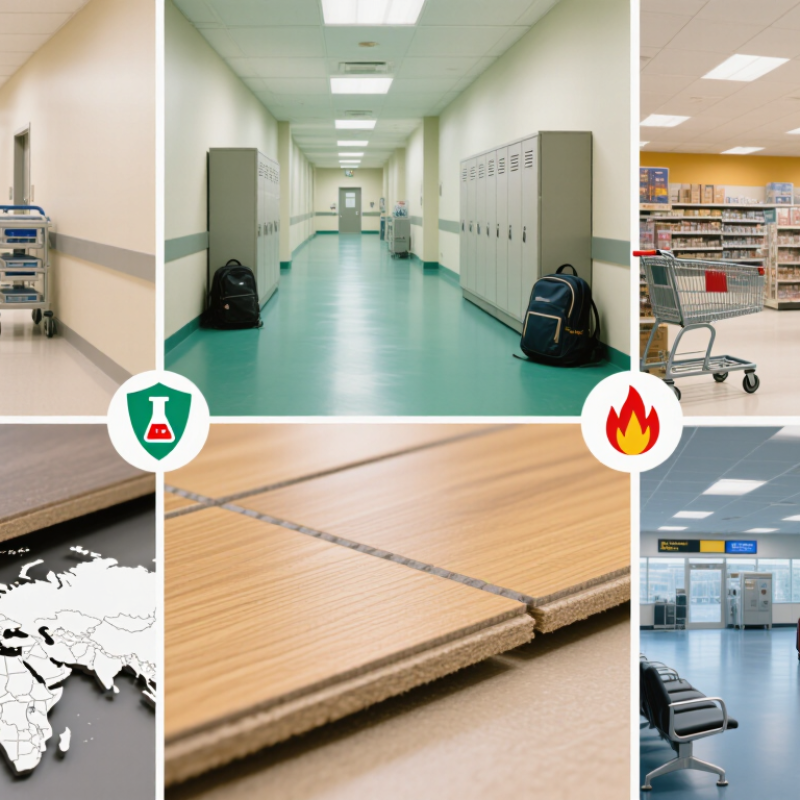
Performance targets should be measurable. Define abrasion resistance, indentation recovery, slip behavior, color stability, acoustic needs, and fire performance according to the project specification and applicable local standards. Match tile thickness and wear resistance to actual traffic, not optimistic forecasts. A busy airport entrance can expose weak assumptions within months.

Still, laboratory results do not perfectly predict every site. We once treated cleaning frequency as a fixed number; daily operations changed it. That lesson matters. Leave room for maintenance variation, replacement access, and future use changes. Samples should be tested under realistic lighting and cleaning methods before approval. A small trial area can reveal glare, seam visibility, or marking problems that paperwork cannot.
Understanding Homogeneous Vinyl Tile Construction and Composition

Homogeneous vinyl tile is built as one dense, consistent layer. Its PVC binder, mineral fillers, pigments, plasticizers, and stabilizers run through the full thickness. There is no printed wear layer hiding a weaker core. This construction allows surface patterns to continue after years of polishing and traffic. ISO 10582 classifies resilient PVC flooring into four wear groups: T, P, M, and F. Higher groups generally indicate stronger resistance to abrasion. The detail matters in airports, hospitals, and busy public corridors.

Composition still needs careful checking. Published environmental product declarations commonly report results per square metre, including product mass, global-warming impact, energy use, and manufacturing waste. The European Commission’s Level(s) framework also encourages life-cycle reporting for construction products. Ask for these figures, not only a marketing sentence such as “low impact.” A tile with heavy mineral filler may feel stable underfoot, yet transport emissions can rise because of its weight. That trade-off is easy to overlook.

Installation records reveal another truth. Subfloor moisture, adhesive coverage, seam alignment, and rolling pressure often decide performance more than the catalogue description. ASTM F1913 and ISO 10582 provide useful technical reference points, but laboratory ratings cannot reproduce every climate. Tropical humidity, dry continental heating, and sand carried through entrances create different stresses. I would test a sample with local footwear and cleaning routines. That test may challenge the first specification.

How to Choose Homogeneous Vinyl Tile for Global Projects? – Understanding Homogeneous Vinyl Tile Construction and Composition
Category Technical Dimension Typical Data or Composition Selection Considerations for Global Projects
Construction Product structure A single, uniform vinyl layer with consistent composition and color throughout its thickness. It does not normally contain a separate printed wear layer. Suitable for areas where long-term appearance retention, repairability, and resistance to heavy traffic are priorities.
Composition Primary polymer Polyvinyl chloride (PVC), commonly combined with plasticizers, stabilizers, pigments, and mineral fillers. Request a complete technical data sheet and confirm whether the formulation complies with the chemical restrictions applicable in the destination market.
Composition Color distribution Color and pattern extend through the full thickness of the tile, although the visual design may be mottled, granular, or directional. Through-color construction can help reduce the visual impact of scratches and support periodic refinishing or localized maintenance.
Dimensions Common thickness range Approximately 2.0–3.0 mm for many commercial homogeneous vinyl tile products. Select thickness according to traffic level, subfloor condition, acoustic requirements, door clearances, and transition details.
Dimensions Common tile formats Typical square formats include 300 × 300 mm, 450 × 450 mm, and 600 × 600 mm. Other formats may also be available. Confirm actual manufacturing tolerances, installation layout, replacement stock requirements, and local module preferences before ordering.
Performance Commercial classification Many commercial products are designed for heavy-use classifications such as EN ISO 10874 Class 34, while some are also suitable for very heavy commercial or light industrial use, such as Class 43. Use the exact classification stated in the product documentation rather than relying only on thickness or visual appearance.
Performance Wear resistance The full-body construction provides a renewable surface; resistance depends on formulation, surface treatment, maintenance, and traffic conditions. Compare abrasion-test results, maintenance requirements, and expected service conditions. Do not treat homogeneous construction as a substitute for verified test data.
Safety Slip resistance Slip performance varies by surface texture, finish, contamination, and test method. Common European classifications may include R9 or R10 for specific tested products. Specify the required test method and rating for the project location, especially in healthcare, education, transport, food-service, and wet-adjacent areas.
Safety Reaction to fire Flooring may receive classifications such as Bfl-s1 or Cfl-s1 under EN 13501-1, depending on the product and tested installation system. Fire classification is product-specific and may depend on adhesive, substrate, and installation method. Verify the required national or regional code.
Indoor Environment VOC and emissions Emissions are influenced by the vinyl formulation, adhesive, floor preparation materials, and installation conditions. Request current third-party emissions documentation and evaluate the complete floor system rather than the tile alone.
Installation Adhesive installation Usually installed with a compatible full-spread adhesive over a smooth, dry, clean, and properly prepared subfloor. Check moisture limits, alkalinity, substrate flatness, curing time, and adhesive availability in the destination country.
Installation Subfloor requirements The substrate should be structurally sound, level, dry, free from dust and contaminants, and suitable for resilient flooring installation. Uncontrolled moisture, cracks, unevenness, or residual construction chemicals can cause bond failure, telegraphing, or dimensional problems.
Maintenance Routine care Regular dust removal, damp cleaning, use of neutral or manufacturer-approved cleaners, and periodic maintenance according to traffic level. A documented maintenance plan can improve appearance retention and reduce the need for aggressive chemical or mechanical treatment.
Maintenance Repairability Individual tiles can generally be removed and replaced when compatible spare material is available. Order an appropriate percentage of attic stock and preserve batch information for future repairs, especially for multi-country projects.
Sustainability Recycled content and recyclability Availability of pre-consumer or post-consumer recycled content varies by product. Recycling routes depend on collection, contamination, and local infrastructure. Request verified recycled-content declarations, environmental product information, and end-of-life guidance applicable to the project region.
Standards Relevant reference standards Common references include ISO 10581 for homogeneous polyvinyl chloride floor coverings, EN ISO 10874 for use classification, EN 13501-1 for reaction to fire, and ASTM standards where North American specifications apply. Confirm the contract standard, edition, testing laboratory, and required marking system before comparing products from different regions.
Global Procurement Climate and logistics Vinyl tiles should be transported and stored flat, protected from extreme heat, cold, moisture, and direct sunlight, and acclimatized before installation. Define packaging, pallet dimensions, storage temperature, lead time, customs documents, and replacement-stock requirements for each country.
Global Procurement Documentation package A complete package may include technical data, installation instructions, safety data, test reports, environmental declarations, cleaning guidance, and warranty terms. Use one controlled documentation schedule so that architects, contractors, inspectors, and facility teams work from consistent information.
Important: The values shown are representative industry ranges and common reference points, not universal product specifications. Final selection should be based on current manufacturer documentation, project test requirements, local regulations, substrate conditions, and the complete installed flooring system.

Comparing Wear Resistance, Safety, and Maintenance Features

For global projects, homogeneous vinyl tile should be judged beyond color and price. In site reviews, I examine traffic maps, trolley routes, doorway grit, and cleaning schedules. The material has consistent composition through its thickness. That helps when repeated wear reaches the surface. Ask for abrasion data, dimensional stability, and suitability for castors. A thicker tile is not automatically better. Poor installation can defeat good specifications.

Wear resistance matters most in entrances, corridors, schools, and healthcare areas. Look for tested performance under the expected use class, not a generic “heavy duty” claim. Factory-applied polyurethane can reduce staining and routine polishing. It does not prevent scratches from sand or sharp furniture. Safety needs equal attention. Check wet slip performance, fire classification, emissions documentation, and surface texture. Very deep texture may improve grip but trap soil. That trade-off is easy to miss.

Maintenance plans should name daily dust removal, neutral cleaning, spill response, and periodic inspection. Use compatible detergents and soft pads; aggressive chemicals may dull the finish. Heat-welded seams can limit moisture entry, but only when installers prepare edges correctly. I prefer sample trials with local water, cleaning tools, and actual wheeled loads. Results can change across climates. Confirm certificates against project-country requirements and obtain current test reports. One weakness remains: predicted service life is never a promise. Keep replacement tiles from the same production batch when possible.

Checking Global Standards, Certifications, and Environmental Criteria

How to Choose Homogeneous Vinyl Tile for Global Projects?

Global projects need more than a attractive color chart. They need verifiable compliance. Check the tile against relevant standards, such as ISO 10582 or applicable regional specifications. Confirm dimensional stability, wear resistance, fire behavior, and slip performance. Requirements can change between countries. A certificate is not a universal passport.

Ask suppliers for current test reports, certification scopes, and laboratory details. Check whether the documents cover the exact product, thickness, and production site. Review VOC emissions, restricted substances, and indoor air requirements. Environmental claims should include evidence, not only friendly wording. An Environmental Product Declaration can clarify lifecycle impacts, while recycled content needs independent verification.

Site experience matters too. Request samples and inspect seams under real lighting. Test cleaning methods on a small area. Confirm that local installers understand moisture control and adhesive requirements. I have seen attractive materials fail because the subfloor was rushed. That lesson is easy to overlook. Also examine end-of-life options, maintenance chemicals, packaging, and transport distance. Some projects select a low-emission tile, yet ignore frequent replacement. That weakens the environmental result. Compare the full service life, not just the purchase price. When standards conflict, obtain written guidance from the project consultant and local authority. Keep every document traceable. A careful decision may still contain uncertainty, but hidden assumptions should never guide a global specification.

Planning Sourcing, Installation, and Long-Term Lifecycle Costs

Choosing homogeneous vinyl tile for a global project begins with the entire cost picture, not the purchase price. In my project reviews, a low-cost tile often became expensive after shipping, adhesive changes, and replacement delays. Compare tile prices with freight, import duties, local storage, and expected installation waste. Keep samples in the actual lighting. Color and surface texture can change sharply under warehouse LEDs. Details matter.

Ask suppliers for technical data, batch consistency records, slip resistance results, dimensional stability, and maintenance guidance. Prefer test reports from accredited laboratories, and confirm their scope. Verify documents against applicable local building and fire requirements. Do not assume one specification serves every country. A humid coastal site may need different adhesive controls than a dry inland school. Order a small approved batch before full production. This exposes shade variation early. Problems surface. I once underestimated lead-time risk by trusting a quoted production date; a port delay disrupted the installation sequence. Build contingency stock, but avoid excessive inventory that may age or become obsolete.

Installation costs depend on substrate preparation, installer skill, room access, and working hours. Include moisture testing, leveling, cutting around columns, and sealing details where required. A clean, stable substrate usually protects the lifecycle budget better than a cheaper tile. Plan daily cleaning methods with facility staff before handover. Track water, chemicals, labor, and periodic repairs for at least ten years. Some calculations will be imperfect because local labor rates change. That is acceptable. Recheck them annually. Select tiles that can be replaced by zone, with spare cartons stored under controlled conditions. Long-term value comes from installation records, maintenance logs, and actual wear.