Leave Your Message
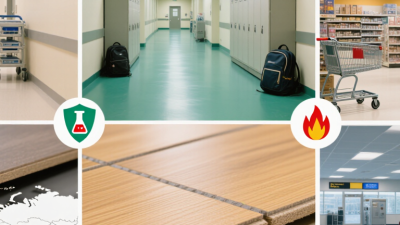
Homogeneous Vinyl Floor remains a practical choice for hospitals, schools, laboratories, retail spaces, and transport facilities. Its single, consistent vinyl layer supports long service life, strong wear resistance, and easier maintenance. Under heavy foot traffic, the surface can often be restored through professional cleaning and polishing. That detail matters.
This guide examines the Top 10 Homogeneous Vinyl Floor Manufacturers Worldwide. It considers product quality, wear-layer performance, installation support, environmental declarations, design consistency, and regional availability. A manufacturer may offer excellent laboratory data but limited local service. Another may provide strong technical support but fewer design options. These differences deserve attention.
Flooring consultant David Russell once observed, “A floor should perform quietly, even when the building does not.” That practical view reflects the real demands of commercial flooring. Buyers need more than attractive samples. They need documented slip resistance, reliable welding systems, stable dimensions, and maintenance guidance that works outside the showroom. Small details can become expensive problems.
The ranking is not perfectly universal. Market conditions, certification systems, and project budgets vary between countries. Some information may also change as manufacturers update collections or production methods. That limitation should be acknowledged.
Readers should compare technical datasheets, verified sustainability claims, warranty terms, and installer recommendations before making a decision. A Homogeneous Vinyl Floor is not simply a colored surface. It is part of a building’s daily safety, hygiene, acoustic comfort, and operating cost. The strongest manufacturers understand that performance must continue long after installation.

Top 10 Homogeneous Vinyl Floor Manufacturers Worldwide
Global Homogeneous Vinyl Flooring Market Scope and 2026 Industry Metrics
The global homogeneous vinyl flooring market is entering 2026 with demand shaped by healthcare, education, transport, and commercial interiors. These projects require consistent color, dense wear layers, low maintenance, and reliable infection-control performance. Market assessments should track revenue, shipment volume, production capacity, regional sales, and tender activity. Price alone gives an incomplete picture.
A credible top-ten manufacturer review should compare product durability, welding performance, slip resistance, installation support, and environmental disclosures. It should also examine manufacturing locations and supply reliability across Europe, Asia-Pacific, North America, and emerging markets. In 2026, recycled content, take-back systems, and life-cycle data will influence purchasing decisions more strongly. Yet sustainability claims still need independent verification.
Field experience shows that flooring can fail when subfloor moisture, seam preparation, or cleaning chemicals are overlooked. Small details matter. Buyers should request technical sheets, test reports, warranty terms, and references from similar facilities. Market forecasts remain useful, but they are not perfect. Construction delays, raw material costs, and changing healthcare standards can shift regional results quickly. A careful assessment should therefore separate confirmed metrics from estimates and explain the limits of each comparison.
| Rank | Anonymized Manufacturer Profile | Primary Global Market Coverage | Typical Product Format | Typical Total Thickness | Wear-Layer Configuration | Relevant Performance Classification | Common Standards and Regulatory References | Principal End-Use Segments | 2026 Industry Metric Focus |
|---|---|---|---|---|---|---|---|---|---|
| 1 | Global Profile A | Europe, North America, Asia-Pacific | SheetTile | Approximately 1.5–3.2 mm | Homogeneous construction; wear resistance is provided through the full product thickness | Commercial classes 31–34; selected industrial classes 41–43 under ISO 10874 | EN ISO 10581; ISO 10874; REACH requirements where applicable | Healthcare, education, offices, retail, transport interiors | Institutional renovation demand and lifecycle cost |
| 2 | Global Profile B | North America, Latin America, Europe | Sheet | Approximately 2.0–3.0 mm | Solid homogeneous PVC construction with factory-applied surface treatment on selected products | Heavy commercial use; classification depends on the declared product construction | ASTM F1913; ASTM F137; ASTM F925; applicable indoor-air-quality programs | Hospitals, laboratories, schools, public buildings | Low-emission specifications and heat-welded seam adoption |
| 3 | Global Profile C | Western Europe, Middle East, Africa | SheetTile | Approximately 2.0–3.2 mm | Full-thickness homogeneous wear performance; some collections support contrasting inlays | Commercial classes 33–34 under ISO 10874 | EN ISO 10581; EN 14041; CE marking requirements for applicable construction products | Healthcare, hospitality, government, education | Public-sector procurement, cleanability and slip-resistance requirements |
| 4 | Global Profile D | East Asia, Southeast Asia, Oceania | SheetTile | Approximately 1.5–3.0 mm | Homogeneous PVC with compact or expanded mineral-filled formulations | Commercial classes 31–34; product-specific fire and slip classifications | ISO 10581; ISO 10874; local fire, smoke and emissions regulations | Hospitals, rail facilities, commercial interiors, education | Healthcare construction and regional infrastructure investment |
| 5 | Global Profile E | Europe, Central Asia, North Africa | Sheet | Approximately 2.0–3.0 mm | Homogeneous sheet designed for heat-welded joints and seamless installation details | Commercial classes 32–34 under ISO 10874 | EN ISO 10581; ISO 9239-1 for radiant-flooring fire testing where specified | Healthcare, laboratories, clean areas, institutional buildings | Seam performance, hygiene maintenance and replacement cycles |
| 6 | Global Profile F | United States, Canada, Latin America | TileSheet | Approximately 1.5–3.2 mm | Solid vinyl construction; tile products are generally installed with factory-defined joint layouts | Heavy commercial use subject to project specification and ASTM testing | ASTM F1700 for solid vinyl tile; ASTM F1913 for applicable sheet products | Retail, education, healthcare, workplaces | Commercial replacement activity and installation productivity |
| 7 | Global Profile G | Nordic countries, Western Europe, Oceania | Sheet | Approximately 2.0–3.0 mm | Homogeneous formulation with emphasis on cleanability, dimensional stability and repairability | Commercial classes 33–34; slip and fire ratings are product-specific | EN ISO 10581; ISO 10874; national environmental product requirements | Healthcare, senior living, schools, public facilities | Environmental product declarations and circularity reporting |
| 8 | Global Profile H | China, India, Southeast Asia, Middle East | SheetTile | Approximately 1.5–3.0 mm | Homogeneous PVC products for medium- to heavy-duty commercial interiors | Commercial classes 31–34 under ISO 10874 or equivalent national systems | ISO 10581; local product conformity, fire and volatile-emission regulations | Hospitals, schools, offices, retail and hospitality | Urban construction, healthcare capacity and specification conversion |
| 9 | Global Profile I | Southern Europe, Latin America, Africa | TileSheet | Approximately 1.5–2.5 mm | Homogeneous vinyl designed for economical maintenance and high foot-traffic areas | Commercial classes 31–33; higher classes require product-specific certification | ISO 10581 or relevant national equivalents; project-specific fire testing | Retail, offices, education, hospitality and public buildings | Price-performance positioning and renovation volume |
| 10 | Global Profile J | Global export markets with regional distribution networks | SheetTile | Approximately 2.0–3.2 mm | Homogeneous construction with options for acoustic backing or specialty surface treatments | Commercial classes 32–34; industrial use is application- and product-specific | ISO 10581; ISO 10874; applicable fire, slip, emissions and chemical-resistance tests | Healthcare, transportation, retail, offices and public infrastructure | Export share, project specification activity and sustainable-material demand |